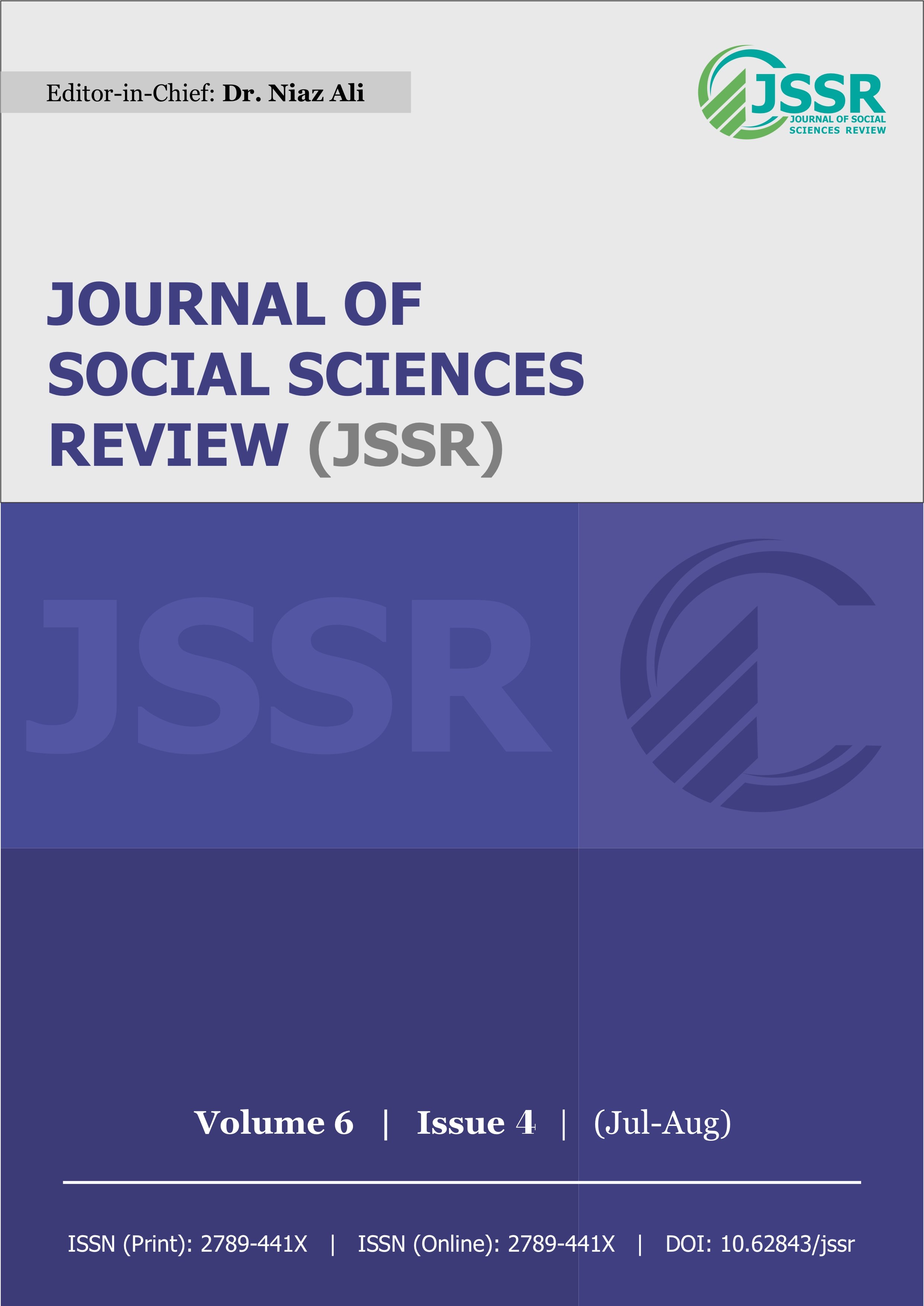
From Lessons to Likes: Exploring Pakistani English Teachers’ Instagram Brand Identities
DOI:
https://doi.org/10.62843/jssr.v6i4.790Keywords:
Teacher Identity, Personal Branding, Instagram, Looking-Glass Self, English Language Teaching, PakistanAbstract
The use of social media has become a daily practice in modern times. It has also been observed that teachers and students frequently use it for academic purposes. This study examined how Pakistani English instructors build their Instagram identities, what factors drove these teachers to build Instagram identities, and how students perceive them. The sample comprised six Pakistani English teachers and 18 student followers. The framework of Looking-Glass Self theory has been employed to determine how English teachers construct their Instagram identities in the Pakistani context, how students perceive these identities, and what impact these perceptions have on the content of their Instagram profiles. Data were collected by means of semi-structured interviews. The responses of the participants were analyzed through a thematic analysis. This thematic analysis revealed three different identities (‘professional self’, ‘role model self’, and ‘influencer self’) that Pakistani instructors wished to build on Instagram. The results revealed Pakistani instructors’ preference towards maintaining professional self and role model self as compared to influencer self, which may be due to the conventional image of a teacher in Pakistani society. The study also highlights the impact of feedback from followers on the self-perception of instructors and their choice of techniques to build Instagram brand identities. The findings highlight the relationship between social media and teacher identity in Pakistan and have significant implications for language teachers’ education and research.
References
Barkhuizen, G. (2016). A short story approach to analyzing teacher (imagined) identities over time. TESOL Quarterly, 50(3), 655–683. https://doi.org/10.1002/tesq.311
Beauchamp, C., & Thomas, L. (2009). Understanding teacher identity: An overview of issues in the literature and implications for teacher education. Cambridge Journal of Education, 39(2), 175–189. https://doi.org/10.1080/03057640902902252
Braun, V., & Clarke, V. (2006). Using thematic analysis in psychology. Qualitative Research in Psychology, 3(2), 77–101. https://doi.org/10.1191/1478088706qp063oa
Carpenter, J. P., Morrison, S. A., Craft, M., & Lee, M. (2020). How and why are educators using Instagram? Teaching and Teacher Education, 96, Article 103149. https://doi.org/10.1016/j.tate.2020.103149
Carpenter, J. P., Shelton, C. C., & Schroeder, S. E. (2023). The education influencer: A new player in the educator professional landscape. Journal of Research on Technology in Education, 55(5), 749–764. https://doi.org/10.1080/15391523.2022.2030267
Chao, C. (2022). Being a YouTuber that language learners recognize: A study on constructing language teacher identities in social media community of practice. System, 109, Article 102860.
Charlesworth, A. (2014). An introduction to social media marketing. Routledge.
Cooley, C. H. (1922). Human nature and the social order. Charles Scribner's Sons.
Creswell, J. W., & Poth, C. N. (2018). Qualitative inquiry and research design: Choosing among five approaches (4th ed.). SAGE Publications.
Curran, N. M., & Jenks, C. (2023). Gig economy teaching: On the importance and dangers of self-branding in online markets. Applied Linguistics, 44(3), 442–461.
Davis, S., & Yi, J. (2022). Double tap, double trouble: Instagram, teachers, and profit. E-Learning and Digital Media, 19(3), 320–339.
Djafarova, E., & Rushworth, C. (2017). Exploring the credibility of online celebrities’ Instagram profiles in influencing the purchase decisions of young female users. Computers in Human Behavior, 68, 1–7. https://doi.org/10.1016/j.chb.2016.11.009
Ho, W. Y. J. (2023). Discursive construction of online teacher identity and legitimacy in English language teaching. Learning, Media and Technology. https://doi.org/10.1080/17439884.2023.2259295
Izadinia, M. (2013). A review of research on student teachers' professional identity. British Educational Research Journal, 39(4), 694–713. https://doi.org/10.1080/01411926.2012.679614
Jin, S. A. A., & Phua, J. (2014). Following celebrities’ tweets about brands: The impact of Twitter-based electronic word-of-mouth on consumers’ source credibility perception, buying intention, and social identification with celebrities. Journal of Advertising, 43(2), 181–195. https://doi.org/10.1080/00913367.2013.827606
Kelly, N., & Antonio, A. (2016). Teacher peer support in social network sites. Teaching and Teacher Education, 56, 138–149.
Khamis, S., Ang, L., & Welling, R. (2017). Self-branding, ‘micro-celebrity’ and the rise of social media influencers. Celebrity Studies, 8(2), 191–208. https://doi.org/10.1080/19392397.2016.1218292
Khedher, M. (2014). Personal branding phenomenon. International Journal of Information, Business and Management, 6(2), 29–40.
Kreber, C. (2009). Academics’ teacher identities, authenticity and pedagogy. Studies in Higher Education, 35(2), 171–194. https://doi.org/10.1080/03075070902953048
Krutka, D. G., Carpenter, J. P., & Trust, T. (2017). Enriching professional learning networks: A framework for identification, reflection, and intention. TechTrends, 61(3), 246–252. https://doi.org/10.1007/s11528-016-0141-5
Landon, E. L., Jr. (1974). Self-concept, ideal self-concept, and consumer purchase intentions. Journal of Consumer Research, 1(2), 44–51. https://doi.org/10.1086/208598
Madhavaram, S., Badrinarayanan, V., & McDonald, R. E. (2005). Integrated marketing communication (IMC) and brand identity as critical components of brand equity strategy: A conceptual framework and research propositions. Journal of Advertising, 34(4), 69–80. https://doi.org/10.1080/00913367.2005.10639213
Matsuda, P. K. (2016). Second language writing teacher identity. In G. Barkhuizen (Ed.), Reflections on language teacher identity research (pp. 248–253). Routledge.
Nejadghanbar, H., & Fotouhi, M. (2024). Teachers as Digital Influencers: Mapping the Construction and Perception of Brand Identities on Instagram. In Teachers as Digital Influencers: Mapping the Construction and Perception of Brand Identities on Instagram.
Nejadghanbar, H., Song, J., & Hu, G. (2024). English language teachers’ emotional vulnerability in the era of self-branding on social media. TESOL Quarterly, 58(4), 1734–1760. https://doi.org/10.1002/tesq.3312
Nejadghanbar, H., & Shaahdadi, M. (2025). English language teacher identity construction on Instagram: A looking-glass self theory perspective. System, 132, Article 103696. https://doi.org/10.1016/j.system.2025.103696
Risser, H. S. (2013). Virtual induction: A novice teacher's use of Twitter to form an informal mentoring network. Teaching and Teacher Education, 35, 25–33.
Rosell-Aguilar, F. (2018). Autonomous language learning through a mobile application: A user evaluation of the Busuu app. Computer Assisted Language Learning, 31(8), 854–881.
Saldaña, J. (2016). The coding manual for qualitative researchers (3rd ed.). SAGE Publications.
Silva, C. S., & Calheiros, M. M. (2022). Youth’s self-construction in the context of residential care: The looking-glass self within the youth-caregiver relationship. Children and Youth Services Review, 132, Article 106326. https://doi.org/10.1016/j.childyouth.2021.106326
Song, J., & Nejadghanbar, H. (2024). Consumerist discourses on social media and language teacher educator identity tensions. TESOL Journal, 15(4). https://doi.org/10.1002/tesj.877
Swennen, A., Jones, K., & Volman, M. (2010). Teacher educators: their identities, sub‐identities and implications for professional development. Professional Development in Education, 36(1–2), 131–148. https://doi.org/10.1080/19415250903457893
Thomas, L., & Beauchamp, C. (2018). Learning to live well as teachers in a changing world: Insights into developing a professional identity in teacher education. Journal of Educational Thought, 41(3), 229–244. https://doi.org/10.55016/ojs/jet.v41i3.52496
Wang, J., & Curran, N. M. (2024). Competing for views and students: The implications of platformization for online language teaching. TESOL Quarterly. https://doi.org/10.1002/tesq.3354
Yasmin, M. (2022). Online chemical engineering education during the COVID-19 pandemic: Lessons learned from Pakistan. Education for Chemical Engineers, 39, 19–30. https://doi.org/10.1016/j.ece.2022.02.002
Yasmin, M., Fatima, W., & Irshad, I. (2025). Evaluating ChatGPT’s effectiveness in enhancing argumentative writing: A quasi-experimental study of EFL learners in Pakistan. Sustainable Futures, 10, Article 100809. https://doi.org/10.1016/j.sftr.2025.100809
Yazan, B. (2017). “It just made me look at language in a different way”: ESOL teacher candidates’ identity negotiation through teacher education coursework. Linguistics and Education, 40, 38–49.
Yousaf, F., & Yasmin, M. (2023). East meets West: Celebrity motherhood portrayals on Instagram and their impact on maternal self-esteem. Kashmir Journal of Language Research, 26(2), 177–193.
Zhao, S. (2005). The digital self: Through the looking glass of telecopresent others. Symbolic Interaction, 28(3), 387–405. https://doi.org/10.1525/si.2005.28.3.387
Downloads
Published
Issue
Section
License
Copyright (c) 2026 Copyright in the Journal of Social Sciences Review is retained by the author(s). Authors also grant any third party the right to use the article freely as long as its integrity is maintained and its original authors, citation details and publisher are identified.

This work is licensed under a Creative Commons Attribution-NonCommercial 4.0 International License.
JSSR's Editorial Board shares the vision of providing free access to information, education, and science for everyone, thus promoting its content through an OPEN ACCESS POLICY, fulfilling the DOAJ definition of open access. The JSSR adheres to an Open Access and Copyright Licensing Policy based on the belief that making research freely accessible to the public promotes greater global knowledge sharing.
The JSSR uses the Creative Commons Attribution-NonCommercial 4.0 International License. The authors who apply and publish in JSSR consent to abide by the copyright policy set out in the Creative Commons 4.0 license (Attribution-NonCommercial 4.0 International license).
- Copyright in the Journal of Social Sciences Review is retained by the author(s).
- Authors also grant any third party the right to use the article freely as long as its integrity is maintained and its original authors, citation details and publisher are identified.
While "By 'open access' to this literature, we mean its free availability on the public internet, permitting any users to read, download, copy, distribute, print, search, or link to the full texts of these articles, crawl them for indexing, pass them as data to software, or use them for any other lawful purpose, without financial, legal, or technical barriers other than those inseparable from gaining access to the internet itself."